
Pledging Mined Coins to Cover a Hardware Bill
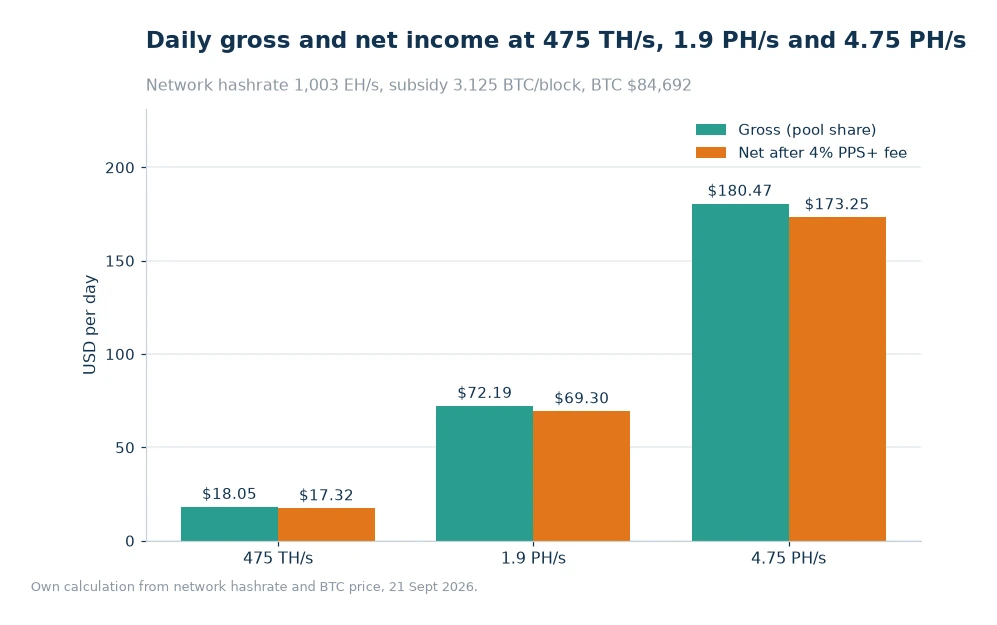
A hardware invoice arrives on a fixed date; mining income arrives in fractions. At 475 TH/s, current conditions produce 0.00021309 BTC a day, worth $18.05 at $84,692 per BTC, or $17.32 after the listed 4% on the block-reward component. Borrowing against coins already mined can bridge that timing gap without selling the stack at whatever price the invoice date happens to bring.

Key takeaways
- At 475 TH/s the daily payout is 0.00021309 BTC, or $18.05 gross and $17.32 net of the listed 4% on the block-reward component.
- Collateral-Pledged Loans keep the coins locked while the borrowed asset is used for the bill.
- The flow is five steps: Add Collateral, Apply for Loan, Receive Loan, Repay Loan, Redeem Collateral.
- At 4.75 PH/s the same inputs give 0.00213088 BTC a day, $180.47 gross and $173.25 net.
Why a hardware bill is a timing problem
Mining income is continuous and small. A new miner, a transformer upgrade or a batch of hash boards is discrete and large. The mismatch is not about total profitability; it is about the shape of the cash flows. Selling coins to meet the invoice is one answer, but it forces a sale on the invoice date rather than on a date the miner would have chosen, and it permanently reduces the stack that the hardware was bought to build.
Pledging changes the shape without changing the ownership. The coins remain in the account as security, the borrowed asset pays the invoice, and the debt is repaid from future mining output. The cost is the loan terms, not a lost position. The risk is that the collateral is valued at market price, so a fall in BTC price can require more collateral or an earlier repayment while the mining income is also falling in dollar terms.
How Collateral-Pledged Loans fit a mining account
The product sits inside the ViaBTC Crypto Loan section of the account, and it is built around Collateral-Pledged Loans: you lock a quantity of coins, draw a loan against them, and recover the coins only after the debt is cleared. Because the mining balance and the pledged balance sit in the same multi-currency account, the daily payout and the collateral are visible together rather than on separate statements.
That visibility is the practical advantage. A miner can see the hourly PPS+ credits arrive while the pledge sits untouched, and can judge whether the next repayment should come from new output or from the existing balance. It also makes the collateral ratio easy to monitor, which matters more than the loan amount when the price is moving.
The five steps and where miners rush
The sequence is fixed: Add Collateral, Apply for Loan, Receive Loan, Repay Loan, Redeem Collateral. Each is a separate action. Add Collateral fixes the security; Apply for Loan sets the amount and terms against it; Receive Loan moves the borrowed asset into the account; Repay Loan clears the debt; Redeem Collateral returns the pledged coins.
The common mistake is treating Receive Loan as the finish line. It is the midpoint. The two steps that decide whether the position is comfortable are the first and the last: how much collateral was locked, and whether there is a plan to unlock it. A borrower who works backwards from Redeem Collateral, with a repayment schedule that the daily payout can cover, has a much calmer position than one who starts from the amount they want to spend.
What the daily payout can service
The income side is the part that can be calculated from public inputs. The table uses the same network hashrate and BTC price throughout, so the rows differ only by machine count. The net column applies the listed 4% to the block-reward component; it does not include power, hosting or the loan terms.
| Hashrate | BTC per day | Gross USD per day | Net USD per day |
|---|---|---|---|
| 475 TH/s | 0.00021309 | $18.05 | $17.32 |
| 1.9 PH/s | 0.00085236 | $72.19 | $69.30 |
| 4.75 PH/s | 0.00213088 | $180.47 | $173.25 |
Read the net column as capacity, not as free cash. If a repayment is due monthly, the relevant figure is 30 times the daily net, minus power and hosting. At 475 TH/s that is about $519.60 a month before those costs. A repayment schedule below that line can be serviced from mining; a schedule above it depends on the collateral or on selling coins, which defeats the purpose of pledging them.
The collateral side moves on its own
Mining output and collateral value respond to the same BTC price, but not in the same way. A price fall reduces the dollar value of the pledged coins immediately and reduces the dollar value of daily output at the same time. Difficulty is the other variable: the next estimate is minus 2.12%, which would lift daily output slightly, but it has no effect on the collateral value at all.
That asymmetry is the reason to size the loan against a stressed price rather than today's. If the position only works at $84,692 and fails at a materially lower price, the pledge is a price bet with a repayment schedule attached. If it works at a lower price with the same hashrate, the collateral has room to absorb a move without forcing a decision at the worst moment.
Worked example
Take 475 TH/s and follow the calculation that produces the chart note, using the inputs read on 21 Sept 2026.
- Daily BTC per TH/s is 450 divided by 1,003,000,000, which equals 4.4865e-07.
- Multiply by 475: 4.4865e-07 times 475 equals 0.00021311 BTC, shown as 0.00021309 after rounding.
- Multiply by the BTC price: 0.00021309 times $84,692 equals $18.05 gross.
- Apply the listed 4% to the block-reward component: 4% of $18.05 is $0.72, leaving $17.32 net.
- Scale to 1.9 PH/s, which is 1,900 TH/s: 0.00085236 BTC, $72.19 gross and $69.30 net.
- Scale to 4.75 PH/s, which is 4,750 TH/s: 0.00213088 BTC, $180.47 gross and $173.25 net.
- Thirty days at the top tier grosses $5,414.10 and nets $5,197.50, a difference of $216.60 for the listed charge on the block-reward side.
Keep the pledge and the payout in one view
A multi-currency wallet is not a loan feature, but it is the reason the loan is manageable. Pledged coins, mined coins and the borrowed asset all appear in the same account, so the collateral ratio and the repayment capacity can be checked without exporting anything. That is a small operational detail with a large effect on how quickly a borrower notices that the position has drifted.
Before pledging, write three figures: the daily net payout at current inputs, the monthly repayment, and the price at which the collateral would need topping up. If the first covers the second with room, and the third is far enough away to give time to react, the five steps are routine. If not, reduce the loan or wait for a wider margin rather than relying on a price recovery.
Frequently asked questions
Do I have to sell my mined coins to repay the loan?
No. Repayment can come from ongoing mining output, from the borrowed asset if it was not fully spent, or from other balance in the account. The pledged coins stay locked until Repay Loan is complete and Redeem Collateral is actioned.
Does the loan change my mining payout method?
No. PPS+ keeps settling hourly against current difficulty and PPLNS keeps settling after 6 confirmations. The pledge sits alongside the mining balance, so the payment method and its listed rates continue as before.
What is the biggest risk in a collateral pledge?
A falling BTC price reduces the collateral value and the dollar value of mining output at the same time. Sizing the loan against a lower price, rather than only the price on the application day, is the main protection.
Model the repayment before the pledge
Start with the daily net figure at your hashrate, multiply by 30, and set the result beside the monthly repayment. Then repeat the calculation at a lower BTC price. If the schedule still fits, the pledge has a buffer; if it does not, the position is leaning on a recovery. The five steps are simple, but the order only stays comfortable when the arithmetic is done before Add Collateral rather than after Receive Loan.
Sources: the ViaBTC loan page for Collateral-Pledged Loans and the five-step flow, plus the pool fee schedule for the listed 4% on the block-reward component. Network hashrate 1,003 EH/s, difficulty 132.76 T, subsidy 3.125 BTC per block, 450 BTC daily and BTC $84,692 were read 21 Sept 2026, published 22 Oct 2026[1]. Every dollar figure is arithmetic on those inputs and moves when they move.